Amherst County Historic Home TourSaturday, May 1, 2004, from 10 a.m. to 4 p.m. Join the Amherst County Museum & Historical Society for a tour of seven wonderful structures in the community of Elon on May 1, 2004. The owners of these homes have generously offered to open them for tours from 10:00-4:00 p.m. Block tickets will be available at the Museum for $12 each and at the door to each home on the morning of the tour. This will get you access to each of the seven sites. Tickets for individual stops will be available at the door for $3 apiece. Tickets are now on sale. To order a block ticket ahead of time send a check clearly marked "House Tour" to: A homemade lunch to be eaten-in or taken on the go will be available at Elon Baptist Church. The cost of lunch is $5 and it will be available from 12 noon until 1:30 PM. Reservations for lunch should be made by April 24, so call the Museum (434) 946-9068 to reserve one, or include $5 when you order your block ticket. The following is a little information on each of these seven stops in the Elon community. Homes in the community of Elon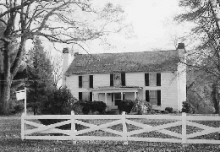 Oak LawnThe current structure was built in 1850 by Sylvester Burford, who owned much of the land extending from the house down to Harris Creek, about two hundred acres or more. His family cemetery is about a half mile further north of the home. The home boasts views of Tobacco Row Mountain. The lawn was shaded by a number of oak trees in earlier years, and several of these trees remain, and so the name "Oak Lawn" has been kept. The old livery stable and a small log cabin are nearby. The icehouse no longer remains. The home was later bought by the Wortham family, and about the turn of the century was owned by the Ewers. In 1954 the property was bought by Harrison and Elizabeth Nesbitt, who sold it to the Farmers in 1989. In 2000 the current owners, Dick and Janet Wills, bought it from the Farmer estate. This is a classic example of a nineteenth century home, originally a "four over four," or four rooms above the four ground floor rooms. Of particular interest are the fireplaces which have been identified as an Improved Rumford design, with a shallow and slanted firebox. 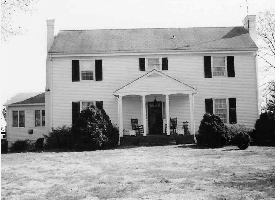 Flint HillThe old plantation house, Twin Oaks, sits inside a broad curve of River Road and was once framed by two massive oak trees. The oaks are now gone, and the estate now is called Flint Hill. Flint Hill is two hundred years old. It is the typical Virginia "I" house of post and beam construction on a brick foundation with chimneys at each end. Additions to the house were made about 1830, again about 1900 and mostly recently in 1969. The Camden family has just this past year completed a renovation of the house. Of particular interest is the large stone fireplace in the basement with a food warmer built into the side and the remnants of a cooking crane. Also, there is evidence of a clay water pipe running from the spring to the house. The original plantation land was divided from nine thousand six hundred acres patented by the Reverend Robert Rose in 1744. Elias Wills built Twin Oaks about 1800 on his plantation of over six hundred acres which once included a grist mill on Harris Creek and a blacksmith shop on the road near the house. 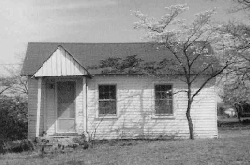 The Elon Community LibraryThe Elon Library opened in 1915 originally in a log cabin, but by 1919 a more permanent structure was built on land Mr. Charles Dameron deeded to the Elon Betterment League. Local residents, civic groups, and the state library contributed the volumes to stock the library. At one time the library housed over two thousand volumes. Chairs and small, round tables were furnished and also the long benches that had been used in the old Triple Oaks School. In 1965 the library was closed, but only temporarily. Miss Phyllis Lea’s determination to keep Elon’s library open paid off and her fund raising skills provided for the necessary repairs and renovations to the building. As a result, it was re-opened, continuing to serve the community into the 1970s, staying open at least one day a week with volunteer librarians. Many organizations contributed to the operation of the library, among them the Elon PTA, the Ruritan Club, the American Legion Post 100, The Elon Baptist Church and the Elon Presbyterian Church. In 1991 it was deeded to the Elon Baptist Church. 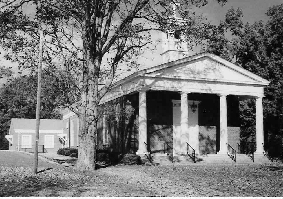 The Elon Baptist ChurchThe Elon Baptist Church was organized in 1877 and met in the Red Brick Church (also known as the Union Church), which was the multi denominational church serving the Elon community. The Baptist congregation united with Cornerstone, New Prospect and Midway churches to collectively call a pastor. In 1908 a white frame church was completed and an educational building was added to the site in 1951. In 1964 the original church was replaced by the current building with additional Sunday School rooms, and in 1995 the current Educational Building replaced the earlier one. In 1897 the congregation joined the Albemarle Association. The church was supported by the Association’s Mission Board until 1949 at which time the congregation became financially independent and called the layman Randall P. Layne to preach and conduct services. An active church program included many youth activities. The Rev. Eugene C. Campbell became the church’s first full-time pastor in 1959. In 1964 the church transferred its membership to the newly organized Lynchburg Baptist Association.  Speed the PloughThe name of the farm is found in the Amherst records as early as 1850, probably coming from an old English Farmer’s Arms, God Speed the Plough. Col. Charles Ellis of Richmond bought the property in 1835. His daughter, Jane, married William Dearing of Rappahannock County. Mr. Dearing bought the property from Charles’ widow, Margaret, on November 16, 1850. The Mansion house is Greek revival style, originally a three-story, six room brick house built shortly after 1850. The Shelton brothers reportedly helped build the house from bricks created on the property. The roof is hipped and there are two chimneys, one on either side of the house, with six fireplaces. The interior walls are 3-4 bricks thick. The doorways are all paneled and the original front door has an unusual pattern of raised gothic arches on each panel. The rooms are two over two with a large central staircase/hallway. In 1925 Rowland Lea purchased the farm and he and his wife had an addition built to the north side of the house for a kitchen and dining room. In 1930 the front porch was enlarged. In the 1920s dry rock walls surrounded the yard, and between 1999 and 2003 Harold McFaden made new walls around the mansion house and guest house.  The Rock House, or CottageThe Rock House, or Cottage, was built in the early 1930s by George M. Stevens, Mrs. Rowland Lea’s brother. Mr. Stevens’ insurance business, located in New York City’s Manhattan district, represented such companies as Lloyd’s of London. Amherst area residents enjoyed the English hunt, as did Mr. Stevens and members of the Lea family. He was inspired to build the rock house, known as the Cottage, for his vacation residence. Also constructed were a barn for his horses, quarters for servants and other outbuildings. George Stevens and the Leas hosted grand square dances in the recreation room complete with wet bar. The room has a wall mural depicting Mr. Lea and Mr. Stevens in riding habit surveying the farm. The Cottage was designed appropriately after an English hunting lodge. The living room has a cathedral ceiling with hand-hewn oak beams, window beds, and a large stone fireplace. The metal arm and iron cooking pot in the fireplace were saved from the separate kitchen that served the brick house during former times. Leading from the living room to the recreation room below is a secret cirular staircase hidden by a library door. The library door on the right hides a secret closet. The cottage exterior is adorned with stone terraces.  Windy HillA visitor’s first impression of Windy Hill Farm is the magnificent view of the Blue Ridge and surrounding countryside. The second feature noticed by the visitor is the large modern barns. The Windy Hill location has been a working farm for over two hundred years and was owned in part and at different times by such prominent Amherst families as the Ruckers, Carters, Cheatwoods and Tinsleys. Ruth Wood Davis, wife of John D. Davis, Jr., acquired 1216 acres about 1930. Later her son James Wood Davis and his wife, Corinne, operated a cattle farm there, calling it Circle View Farm. James W. Davis was a Virginia State Senator from this district for many years. During the Depression years, the Davis family hosted community dances in the haymow of an old barn. Birthdays were celebrated on the lawn and an occasional wedding party was held at the house. The house probably started as a simple farmhouse in the early twentieth century. Additions were made to each end of the two-story house and a kitchen ell was attached to the rear. The comfortable home features a large dining and living area. Today these rooms are accented with rocking horses and other horse memorabilia. |